

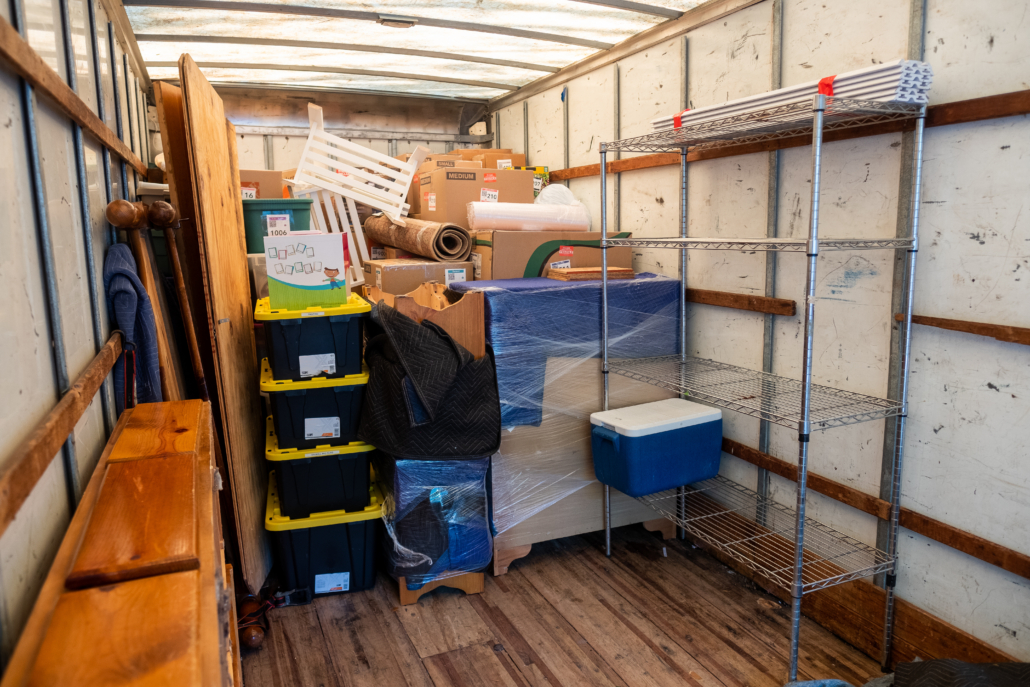
Escaping the U-Haul: What Getting Out of My First Toxic Relationship Taught Me About Pride
Written By: Jessica Nguyen
My lesbian hot take: we need to de-romanticize the U-Haul. I’m not saying abolish it. Let’s just take it off the pedestal, because U-hauling cannot be the gold standard of sapphic love that we’ve made it out to be. I say this from personal experience as someone who saw the U-Haul coming from a mile away, said “I don’t want to be a stereotype,” then sprinted toward it anyway.
Sapphic relationships inherently lend themselves to be intense, fast, and emotionally deep in ways that feel unlike anything else. There’s something about finally being known in the specific way only another woman can see you that makes a slow burn feel unnecessary.
When I met my most recent (now ex-) girlfriend, I thought I was finally getting my canon sapphic experience. Finally done with situationships and one-month talking stages with girls on Hinge. Finally – a woman I can call mine, whom I can love unapologetically, bring to Pride, and show off to the world as my girlfriend.
After years of dating since coming into my identity as a lesbian, I was exhausted. Finding a girlfriend as a sapphic is genuinely hard in a way that’s difficult to explain to people who’ve never done it. Under compulsory heterosexuality, dating men has a certain passivity built in: they pursue you, you think, “He’s good enough, I suppose,” and then that’s your boyfriend. That sequence of events doesn’t exist when you’re looking for your lesbian soulmate. In my first few years of being a sapphic single, I became used to talking stages turning into best friendships and the particular loneliness of being with people who aren’t sure yet what they want from me or from themselves.
So, when I found a woman who was older, financially stable, and adamantly certain she wanted me, I thought the universe had finally answered my prayers. Out of all the successful, beautiful, well-educated women of her age in the DMV that she could have pursued, she wanted me, a broke 24-year-old grad student still living at home with my grandmother. Our connection must be real, I thought.
Within two weeks of knowing each other, I was staying over at her place for half the week. I met her best friends and we shared years of relationship trauma with each other. I drove almost an hour to see her multiple days a week because that is what lovesickness does to you.
At the time, the intensity felt like an affirmation that I was finally receiving the lesbian love I’ve always dreamed about.
When she pushed to make things official before we’d even known each other for a month, I pushed back. I was flattered, but I didn’t want to be the U-Haul stereotype so soon. I wanted us both to be sure, to make sure we knew each other fully before committing. She kept insisting: I know I want you, so why wait?
And so I thought, let’s get the U-Haul.
Truthfully, I was excited to be in my girlfriend era. I thought it meant that I could finally be my authentic self with a partner who would love me because of my big, bright, adventurous personality — not in spite of it.
She had spent weeks presenting herself as someone who wanted to experience everything with me: any event, restaurant, or silly little date that I desired. And so, I believed her and started showing the unedited version of myself as a girlfriend: the enthusiastic, this-made-me-think-of-you, can-we-please-do-this person that I actually am.
In the same week we became official, my date ideas got the following responses:
“I don’t want you to cook at my place.”
“None of this sounds interesting.”
“You’re starting to annoy me.”
The responses were always a cut-and-dry “No” without even a basic courtesy of pretending to consider my ideas. It was just dismissal after dismissal until I finally got the message.
So, I stopped sending things. I figured out that if I didn’t offer anything real, there was nothing for her to use against me. I learned, through repetition, that the version of me she had pursued so aggressively was apparently not the version she wanted once she finally had me. And not knowing what to do with that contradiction, I did the only thing that felt safe: I made myself smaller.
Yet despite my best efforts, she always found some way to criticize me, something to scold me for, to talk down to me like I was a child. I started rationalizing her coldness and blaming myself for it:
“I just need to get to know her style of love better.”
“I can be a good girlfriend as long as I learn how to act in a way that doesn’t piss her off.”
I justified her behavior to my friends the way every survivor does: “But when things are good, it’s really good.” “She’s only grumpy because she’s been working a lot.” Nobody was buying it. My friends who had watched this whole thing unfold from the beginning got angry on my behalf when I was still convincing myself of why it was valid for her to snap at me. They talked me down from multiple sob sessions after arguments I’d have with her. They begged me to leave. And I kept finding reasons not to.
The breakup, when it finally came, was not clean. I went through every stage of grief. I debated for months afterwards whether to break no contact, which I might have done if it weren’t for my friends threatening to cut me off if I reached back out to her. If I “wanted closure so bad,” I had to sit down and write a pros-and-cons list of dating her first.
It ended up being 2 pros and 70 cons.
It took time, distance, getting back into community again, and those 70 line items to understand what had actually happened. At the start, I thought I was living the U-Haul fantasy. We never actually moved in together, but the way our lives were merging so intensely and quickly made the U-Haul feel like the inevitable next step for our relationship.
Looking back, I can name what happened clearly: love-bombing. She never intended to act on those grand promises of trips, pets, or a future together. They were just part of the ploy to pull me in, so that she could eventually control me.
Now, working with Capital Pride to help DC’s Parade and Festival come together this June, I’ve found myself sitting with a strange hypothetical: what would this Pride have looked like for me if I had stayed with her? When we dated, I dreamed about going to the Parade and Festival together. I was so excited to finally have a girlfriend to do Pride with – to have someone to dress up with, dance with, and love audaciously in broad daylight. I thought having a girlfriend was the point. That being in a Queer relationship was itself the best part of Pride.
But Pride, at its core, was never just about the gender of who we love. Pride is rooted in a legacy of hard-fought activism to show our cis-heteronormative world that queer folks exist and we deserve dignity. We deserve to be here, to be seen, to be treated as full human beings worthy of the same rights as everyone else, worthy of care and respect. And if that’s true in our protests, it has to be true in our relationships too.
From that experience, I had to learn the hard way: queer relationships are not automatically safe. Being loved by a woman does not guarantee that you will be loved well. But the version of love I still idealize is out there. It exists; it just won’t ask you to shrink yourself for your partner to love you.
This isn’t to say that de-romanticizing the U-Haul means you have to slow down your love story or shoo away the first signs of emotional intimacy. It means learning to tell the difference between two people falling fast because the connection is real — and one person who needs you committed before you’ve had the time to see them clearly.
It means staying away from the love-bombing lesbian with the 70 red flags.
It means trusting your community when they tell you something is wrong. Your besties — the people who will call out what healthy queer love is supposed to feel like, who will comfort you through the worst month of your early twenties — they are the ones who will bring you back to yourself, to safety, to the love they know you deserve. They are part of your Pride story too.
So yes, Pride is about being proud of who you love. More than that though, it’s also about being proud of the standards you hold for how you’re loved. Honor that.


Leave a Reply
Want to join the discussion?Feel free to contribute!