Listeners:
Top listeners:
-
 play_arrow
Pride 365 The Soundtrack of Pride - All Year Long


The Odyssey Review: Christopher Nolan’s Epic Is a Must-See on the Biggest Screen Possible
There is something wonderfully ironic about hearing people warn others to “avoid spoilers” for The Odyssey. This is a story that’s been around for nearly 3,000 years. If Homer hasn’t spoiled it for you by now, Christopher Nolan probably isn’t going to be the one to do it.
That said, I’ll keep this review focused on the experience rather than the plot because, honestly, the experience is what makes this film so extraordinary.
Christopher Nolan has created one of the most visually magnificent films I have ever seen. Every frame feels intentional. Every location feels impossibly grand. This isn’t simply another historical adventure. It feels like mythology brought to life on a scale that very few filmmakers would even attempt.
I was fortunate enough to see The Odyssey projected on 70mm film. There is something undeniably magical about watching real film projected onto a screen. The texture, the warmth, and the subtle imperfections remind you that you’re experiencing cinema in one of its purest forms.
The theater I attended was equipped with a standard-sized screen for its 70mm presentation. While the image quality was stunning, the presentation on a standard screen crops portions of the frame. Nolan composed this movie for enormous canvases, and that became obvious throughout the film.
If you have access to a true 70mm IMAX presentation, make the trip. Even if that isn’t an option, seek out the largest premium format screen you can find. This is one of those rare movies where the screen itself becomes part of the storytelling. Watching it on the biggest screen possible isn’t just recommended. It’s how this film was meant to be experienced.
The cast is exceptional from top to bottom.
Matt Damon delivers a wonderfully layered Odysseus, balancing the legendary warrior with a man who is exhausted, haunted, and driven by the hope of returning home. He never loses sight of the humanity beneath the myth.
Tom Holland may have surprised me the most. As Telemachus, Odysseus’ son, Holland gives one of the strongest performances of his career. He brings sincerity, determination, vulnerability, and quiet strength to a character who could have easily been overshadowed by the larger-than-life heroes surrounding him. Instead, he becomes one of the emotional anchors of the entire story.
Anne Hathaway brings warmth and resilience to Penelope, even if it felt a bit over-acted at times. This *is* an epic after all. Zendaya continues to prove why she is one of the most compelling performers of her generation, while Lupita Nyong’o commands every scene she’s in with remarkable presence. Robert Pattinson and Charlize Theron both leave memorable impressions despite sharing the screen with an incredibly stacked ensemble.
One casting choice deserves special recognition because of what it represents beyond the film itself.
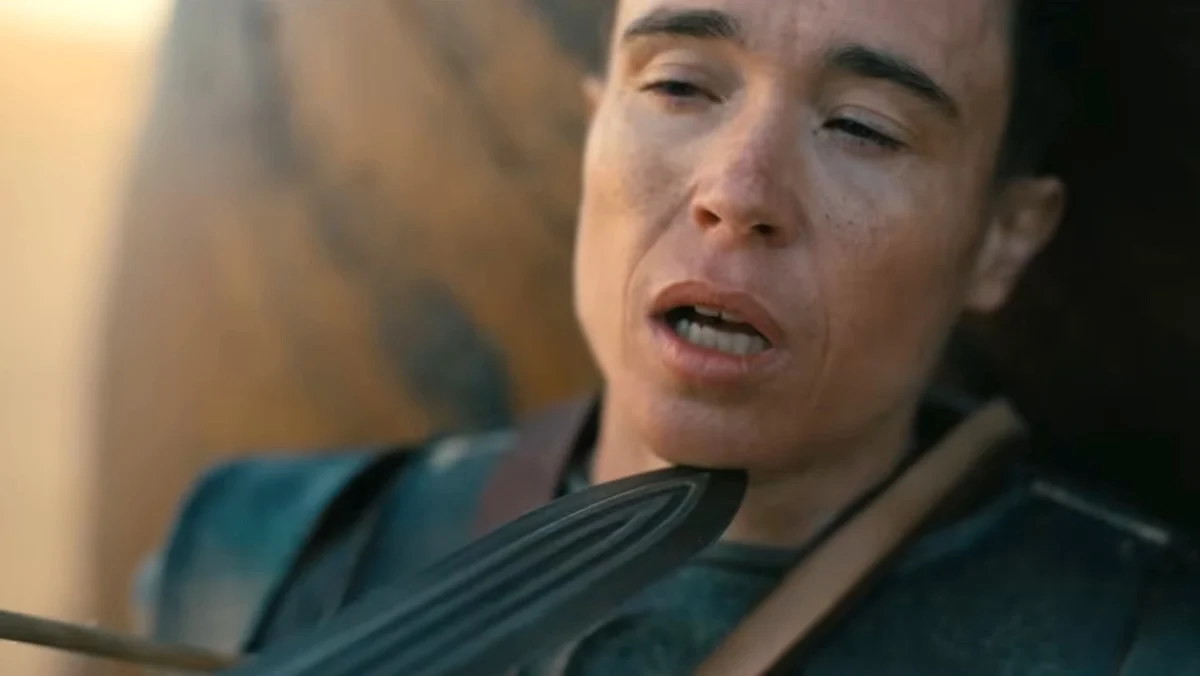
Elliot Page’s inclusion in The Odyssey is genuinely meaningful. Hollywood still offers far too few opportunities for transgender actors to appear in major studio blockbusters without their gender identity becoming the defining characteristic of the role. Here, Page simply gets to be part of one of the biggest cinematic events of the year, standing alongside some of the industry’s most celebrated actors in a story that has endured for thousands of years.
That kind of visibility matters.
For transgender audiences, seeing someone like Elliot Page included naturally in a film of this scale sends an important message that trans actors belong in every genre, every story, and every level of filmmaking. Representation is at its most powerful when it becomes ordinary, and The Odyssey quietly accomplishes exactly that.
What impressed me most is that Nolan never loses sight of the emotional core beneath all the spectacle. Yes, the battles are breathtaking. The creatures are terrifying. The visual effects are astonishing without feeling artificial. But at its heart, this is still a story about family, perseverance, sacrifice, and the longing to find your way home.
Those themes have survived for thousands of years because they remain universally human.
The Odyssey reminds us why movies exist in the first place. They transport us to worlds we could never otherwise experience. They make us feel small in the best possible way. They leave us staring at the credits, realizing we’ve just witnessed something special.
This is not a film that should be rushed through on a streaming service months from now while scrolling your phone.
Find the biggest screen you can. If there’s a 70mm IMAX presentation within driving distance, buy the ticket. If not, choose the largest premium format available.
You’ll be glad you made the journey.
Similar posts

ON AIR NOW
LATEST
TOP CHART
-

1
play_arrowIn Your Eyes (Main)
-

2
play_arrowMovin' To The Sun [Radio Edit]
-

3
play_arrowLove Sensation (Afterhours Radio Edit)
-





Pride 365 is a registered trademark of the Capital Pride Alliance (CPA). CPA is a nonprofit organization dedicated to serving the needs of the LGBTQ+ community, through educational programs, major events, fundraising, outreach and advocacy, providing platforms for visibility, and supporting the work of our many community organizations and local businesses.


Post comments (0)